
The Strategic Value of MCP Adoption
%20(1).jpg)

Moving beyond the technical architecture, the decision to adopt MCP is fundamentally a strategic one, driven by tangible benefits that translate directly into business value, operational efficiency, and competitive advantage. For leaders evaluating this technology, understanding these outcomes is paramount.
Unlocking Efficiency and Innovation: The Core Benefits of MCP
Adopting MCP as a standard for AI integration yields a cascade of benefits that impact everything from development cycles to the quality of AI-driven insights.
- Reduced Development Overhead and Faster Time-to-Market: The most immediate and quantifiable benefit is the radical simplification of the integration landscape. By solving the M×N problem, MCP frees development teams from the drudgery of writing, debugging, and maintaining endless streams of duplicative "glue code". An integration with a key system like a CRM or ERP, once built as a robust MCP server, becomes a reusable asset for the entire organization. This dramatically accelerates the delivery of new AI-powered features and allows teams to focus on innovation rather than plumbing.
- Enhanced AI Performance and Reliability: One of the most persistent challenges with LLMs is their tendency to "hallucinate"—to generate plausible but factually incorrect information. This often occurs when a model lacks the specific, up-to-date context needed to answer a query accurately. MCP directly mitigates this risk by providing AI models with a live, secure channel to authoritative data sources. When an AI can query a product database for real-time inventory or consult an internal knowledge base for the latest policy, its responses become more accurate, relevant, and trustworthy, transforming it from a novelty into a reliable business tool.
- Scalability and Composability: MCP fosters a modular, "plug-and-play" architecture for AI systems. Instead of building monolithic AI applications, organizations can create an ecosystem of composable capabilities. Need to add a new function? Simply develop and connect a new MCP server. This approach allows AI systems to scale in complexity and scope without requiring a complete re-architecture. Over time, an organization can build a library of enterprise-wide AI services that can be mixed and matched to create new, sophisticated applications, much like assembling a system from LEGO bricks.
- Improved Security and Governance: In a world of ad-hoc integrations, security is a decentralized nightmare. Each connection has its own method for handling authentication and permissions, creating a vast and porous attack surface. MCP centralizes and standardizes this process. It provides a single, governable framework for defining and enforcing how AI applications interact with sensitive data. By using established standards like OAuth 2.1 and leveraging the Host application as a central point for user consent, MCP allows organizations to implement consistent security policies across their entire AI ecosystem, ensuring that access to data is both audited and controlled.
- Flexibility and Future-Proofing: Because MCP is an open standard, it prevents vendor lock-in, a critical strategic concern in the rapidly evolving AI market. By building tool integrations on top of MCP, an organization decouples its data infrastructure from its choice of AI model. If a new, more powerful, or more cost-effective LLM becomes available—whether from OpenAI, Anthropic, Google, or the open-source community—the organization can swap it in without having to rebuild every single data connection. This strategic flexibility ensures that the significant investment made in building enterprise integrations remains a durable asset, future-proofing the organization's AI stack.
This collection of benefits reveals a deeper truth about the protocol's impact: MCP fundamentally changes the economics of AI development. It encourages a shift in investment strategy, moving away from building disposable, project-specific integrations and toward creating a durable, reusable platform of enterprise capabilities. An MCP server for a critical business system is not a line item in a single project's budget; it is a strategic asset whose value is amortized and compounded with every new AI application that uses it. This transforms AI integration from a recurring cost center into a high-ROI platform investment.
MCP in Action: Transformative Use Cases Across Industries
The abstract benefits of MCP become tangible when examined through the lens of real-world applications. The protocol's flexibility and power are already enabling transformative solutions across a diverse range of industries, and the ecosystem of available servers has exploded to include integrations for Notion, TwelveLabs (video intelligence), Jasper (brand intelligence), SnapLogic, and many more.
Software Development

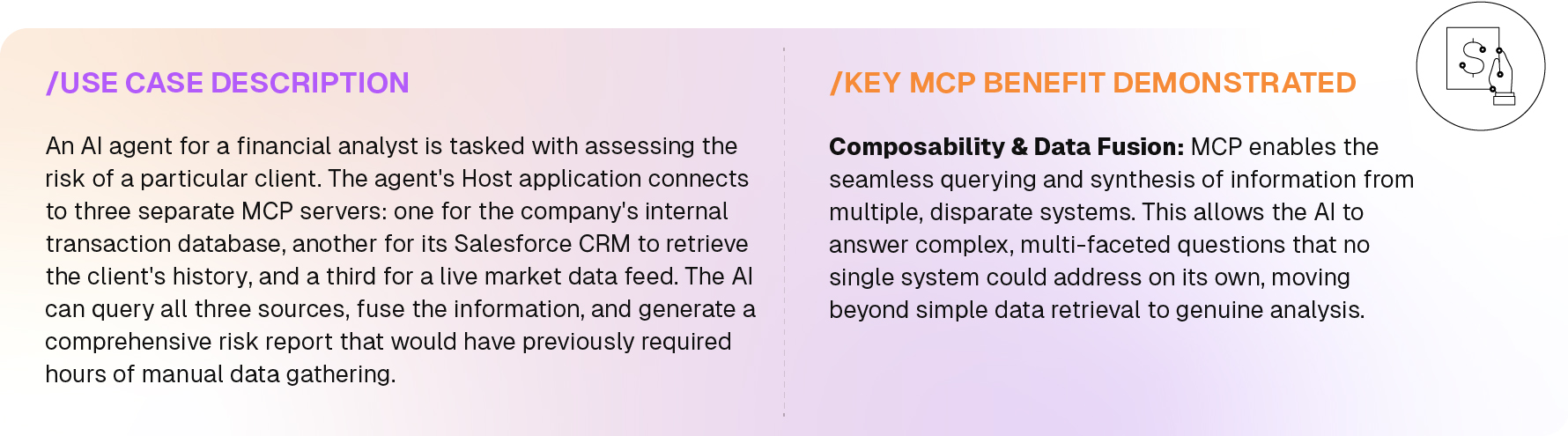
Enterprise & Finance
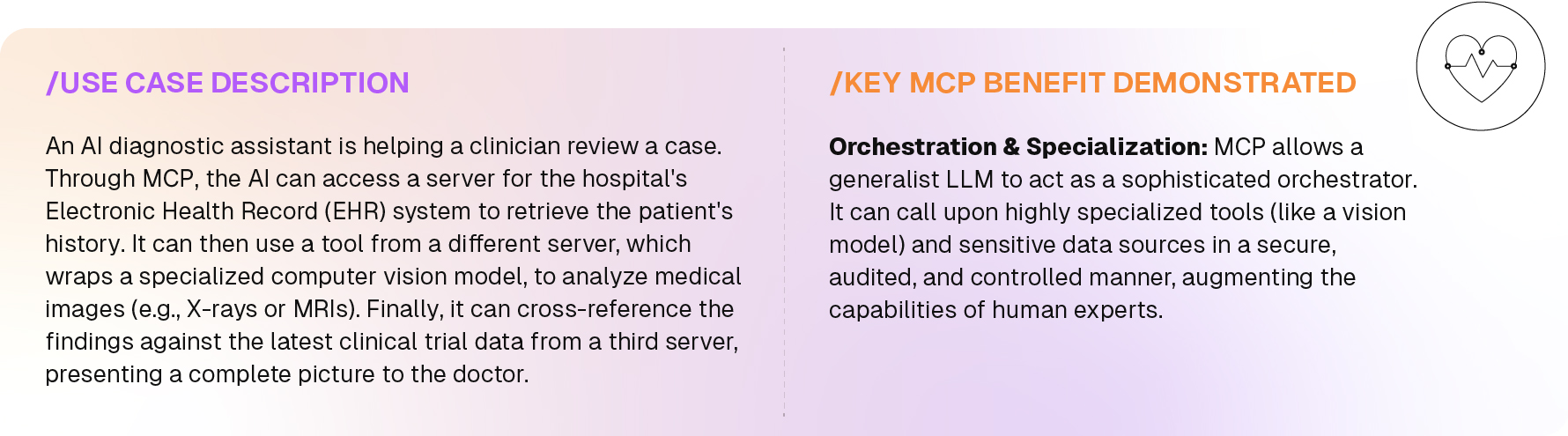
Healthcare
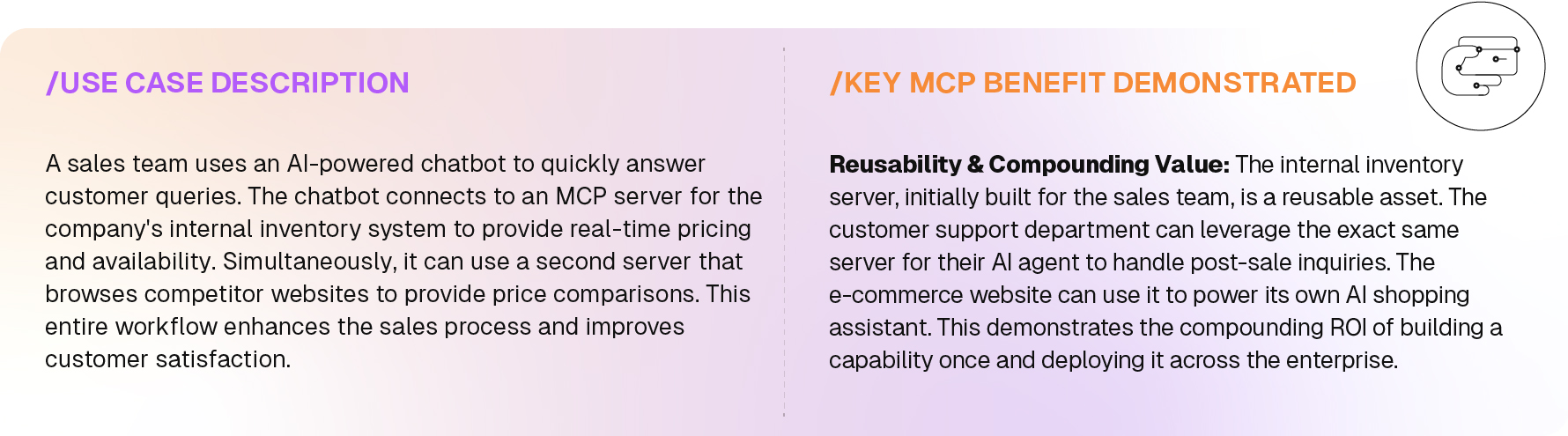
Sales & E-commerce
MCP is quickly becoming a cornerstone for organizations looking to scale AI with reliability, speed, and control. By standardizing how systems connect, it turns integrations into long-term assets rather than recurring obstacles. If you’re considering how this standard could elevate your AI strategy, our team at Switch is ready to help you take the next step.
Make sure to read Part 1: Understanding the MCP Revolution to gain the full strategic context behind this rapidly evolving standard.