
How the AI-Driven Development Lifecycle Reimagines Delivery
.jpg)

This article is for CTOs, engineering leaders, and digital transformation executives who need to accelerate software delivery without sacrificing the governance, traceability, and accountability their organizations demand. It explores the AI-Driven Development Lifecycle (AI-DLC), a software delivery framework introduced by AWS that goes beyond autocomplete and code assistants toward a fully structured approach where AI plans and executes while people decide and validate. The article covers what AI-DLC actually is, how it works across the three phases of Inception, Construction, and Operation, and why it represents a practical path forward for organizations
For the last two years, almost every conversation about AI in software has circled the same question: how much should we let it do? Most organizations have landed on one of two answers, and both have quietly disappointed.
The first answer is AI-assisted development: keep your existing process exactly as it is, and bolt AI onto the edges. Autocomplete here, a test stub there, a documentation draft when someone remembers to ask. It's safe, it's incremental, and it leaves the vast majority of AI's potential on the table. The second answer is AI-autonomous development: hand the AI a prompt and hope a finished application comes out the other side. It's fast in a demo and fragile in production — unexplainable, hard to audit, and a non-starter for any client operating under real regulatory scrutiny.
There's a third way, and it's the one we believe will define the next decade of software delivery: the AI-Driven Development Lifecycle (AI-DLC), a methodology introduced by AWS that stops treating AI as an accessory and starts treating it as a core member of the team.
What AI-DLC actually is
AI-DLC is built on a deceptively simple idea: the AI plans and executes; people decide and validate. Everything else follows from keeping those two roles in balance.
In practice, that rests on two dimensions that always work together. The first is AI-powered execution with human oversight , where the AI builds detailed work plans, drafts requirements, proposes architecture, writes code and tests, but it actively asks for clarification and defers every critical decision to a human. Only people carry the business context and accountability needed to make those calls. The second is dynamic team collaboration, because the AI absorbs the routine heavy lifting, the team's time shifts from isolated, fragmented tasks to high-energy, real-time problem solving together.
The result is a different shape of work entirely. Engineers move from writing code line by line to directing, reviewing, and validating what the AI produces. The unit of progress is no longer the multi-week sprint but the "bolt", an intense cycle measured in hours or days. And the team builds precisely what it intended, rather than an abstract machine interpretation of a vague brief.
How it works: plan, clarify, validate, execute
At the heart of AI-DLC is a loop that repeats at every scale of the project:
A person expresses an intention in business language. The AI proposes a plan and asks structured questions about anything ambiguous or incomplete. The person clarifies, the plan is refined, and — only after explicit human approval — the AI executes and produces the artifact. The person verifies the result before anything advances. Nothing significant moves forward without a human in the loop.
That loop runs across three phases, each one handing richer context to the next:
- Inception turns business intent into detailed requirements, user stories, and independent units of work — before a single line of code is written. This is the most collaborative phase, and the decisions made here shape everything downstream.
- Construction turns each unit of work into tested, deployable software. The AI proposes architecture, domain models, code, and a full test suite; the team validates the technical choices in real time.
- Operation deploys via infrastructure-as-code and CI/CD with team oversight, and then continuously monitors production. What it learns — incidents, usage signals, technical debt — becomes the input for the next cycle, closing the loop.
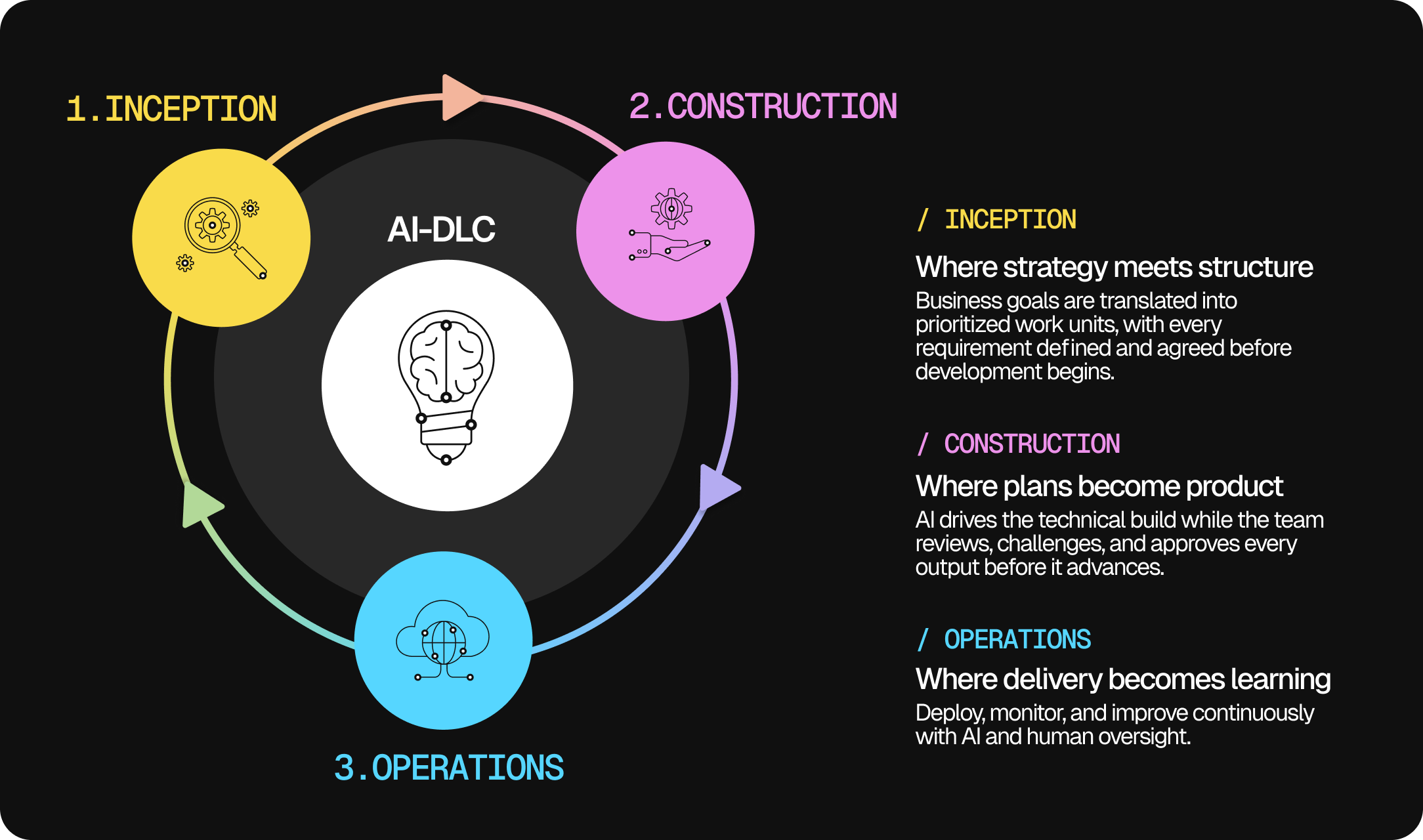
Crucially, the AI doesn't just hold context in a fleeting chat. Plans, requirements, and design decisions are written to the project repository, so work survives across sessions and every decision stays traceable.
Why AI-DLC matters for the business
The headline benefit is velocity: work that used to take weeks — requirements, designs, code, tests — gets generated and refined in hours or days. But velocity is only the entry point. The deeper gains compound from there:
- Innovation, because freeing people from repetitive work gives them room to explore better solutions.
- Quality, because continuous clarification keeps the product aligned to business intent, and the AI consistently applies your coding standards, design patterns, and security requirements while generating comprehensive tests.
- Market responsiveness, because short cycles let teams react to user feedback and changing demands almost immediately.
- A better developer experience, because engineers spend their time on judgment and problem-solving instead of boilerplate — and they can see, directly, how their work moves business value.
Where Switch comes in
Adopting a methodology is easy to announce and hard to operationalize. The evidence across the industry is consistent: most enterprise AI initiatives don't fail on technology — they fail on change management, data quality, and a lack of clarity about who is accountable for what.
That gap is exactly where we work. As an AWS partner, Switch hasn't just adopted AI-DLC as a concept — we've turned it into a governed, repeatable practice, with the controls that make it safe to run in the industries we serve: financial services, the public sector, logistics, retail, and hospitality across Latin America, the Caribbean, and the United States.
For us, governance isn't a checkpoint at the end; it's built into the lifecycle from the first conversation. Because an AI agent can generate an enormous volume of change in very little time, the controls have to be automatic, continuous, and — when it counts — blocking. Every phase closes with an explicit human approval that can't be skipped. Every decision, AI proposal, and sign-off is captured in an append-only audit trail. Every test traces back to a requirement, and every requirement back to a user story. And when a project includes generative-AI components, we evaluate them against the dimensions of responsible AI — fairness, explainability, privacy, safety, controllability, robustness, and transparency before anything ships.
That combination is what makes the difference for a regulated client. AI-autonomous development can't survive an audit. AI-assisted development can't deliver the velocity. AI-DLC, run with discipline, gives you both: the speed of an AI-native team and the traceability your compliance obligations demand.
The takeaway
The future of software development isn't about replacing engineers, nor about settling for AI as a fancy autocomplete. It's about positioning AI as a genuine collaborator, one that does the heavy lifting while people stay firmly in control of the decisions that matter.
That's the promise of AI-DLC, and it's how we're already building for our clients. If your organization is ready to move past AI experiments and into AI-driven delivery — with the governance to back it — let's talk about what your first bolt could look like.